


Detailed explanation of the monthly income calculation methodology for the german contracts of Anneberg Transport posted (foreign) drivers
There seems to be a lot of confusion surrounding the wage calculation, particularly from the Romanian drivers working on German contracts.
The wage calculation and the taxation system are strictly regulated by the German government.
It shall come as no surprise that the actual calculations are not made by Anneberg Transport in Grønbjerg, but by the german consultancy company handling the accounting system of the German subsidiary -Anneberg Transport GmbH.
The workflow
1. The process starts with the driver recording the activity in a dual system:
Transics - Driving Report (the blue notepad called KØRSELSRAPPORTER)
2. The dispatchers, will review the Driving Report (KØRSELSRAPPORTER) and reconcile with the number of days worked with the Transics data. The Driving Report will be further used to bill the waiting time to clients and cross check the unpaid leaves of the drivers.
3. A comprehensive ledger with all day worked by all the german contract drivers will be sent to the accounting company in Hemmingstedt.
4. Approximately one week later the payslips are returned to book-keeping (Karin). The administrative office will review them, add any reimbursements and schedule the payments. At a later stage these payslips will be printed and delivered in hard copy to the drivers, and/or uploaded in each driver's private folder on the intranet.anneberg.net.
5. On the last banking day of the month, the payment orders will be executed by the bank and you will receive the money in your bank account, either the same day or the next working day.
Note: the management, does not interfere or control the wage calculation process.
The logic behind the monthly income calculation for a posted (foreign / not living in Germany) driver working on a German contract.
The income is comprised of three main components:
- base salary (festlohn)
- daily expense allowance / per diem (spesen)
- various bonuses (e.g. KA-Prämie)
All these will be visible on the payslip as both quantity and value.
The salary (wage)
The base salary is always gross (taxes included). From this will be deducted all the contributions and this will represent the income taken into account by a financial institution if/when granting a credit.
Until June 2019, the base salary is calculated over a full month period, starting from the 1st of the month and until the last day of the month, with the employee receiving the money in the last working day of the month. As an example for March 2019, the salary will be calculated between 1 March and 31 March 2019 and paid to the drivers on the 29 March.
After June 2019, the drivers will have the base salary calculated starting with the 15th of every month, until the 14th of next month and disbursed to employee in the last working day of the month. As an example for the salary received by the employee on the 30 August 2019, the salary will be calculated between 15 July and 14 August 2019.
For posted (foreign) workers, the salary calculation will be pro-rated against the number of calendaristic days and not the working days in the month (as usually). This daily pro-rated amount will be taken into account when calculating the rest&recovery / unpaid leaves. The first day of work will be considered the first day reporting to work (not the day when you leave your home / the days necessary to travel to the place of work).
Daily expense allowance / per diem
In most countries,
Trips within Germany
For domestic business trips, employees receive the following per diems:
Multi-day trips:
- flat rate of €24 for every 24 hours that they're away from their home and primary workplace
- flat rate of €12 for the day of departure and arrival, if the employee doesn't spend the night at their own home. For the posted (foreign) workers this half day rate applies to the first day and last day when reporting to work (e.g. when arriving from / leaving for home), regardless whether the departure is in a weekday or a weekend.
Single-day trips:
- €12 for the calendar day if the employee spends at least 8 hours away from their home or primary workplace.
Trips outside of Germany
When employees embark on an international trip, different rules apply.
The German government sets per diem amounts for every country according to the cost of living there. Every year a new document is released with all amounts adjusted to the new situation in the various countries.
There are three different rates per destination:
- Rate for 24-hour absence from home and primary workplace ("Verpflegungsmehraufwand")
- Rate for the day of arrival and departure
- Rate for the cost of an overnight stay ("Übernachtungspauschale")
All amounts are listed per country, but exceptionally expensive cities have their own adjusted rate — life in a capital or big city can be considerably more expensive than on the countryside.
For example, according to the new rules of 2019, this is what a German employee travelling to Denmark can claim:
- €58 per full 24 hours
- €39 for the day of arrival and departure
- €143 per overnight stay
Anneberg practice in the matter of the daily expenses allowance / per diem
Due to the fact that the driver job description involves a daily travel, usually over long distances, Anneberg employees are subject to a daily expenses allowance for the period they spend out of their area of residence.
Expenses and holiday arrangements (ger. Spesen und Urlaubsregelung)
Valid from 27.09.2005
Spesen / Charges:
- Monday - Friday: EUR 24,00 / working day
- Driving until Saturday 12:00 pm: EUR 24.00
- Driving Saturday after 12:00 pm: EUR 24,00
- Departure Sunday before 22:00: EUR 8,00 / hour, up to max EUR 24,00
- Whole Saturday: EUR 48,00
- Whole Sunday: EUR 103,00
- Nationwide holiday: EUR 103,00
- Whole weekend: EUR 180,00
The charges are not cumulative, the highest benefit will be applied.
As mentioned above, the posted drivers, will receive for periods of travel spanning over weekends, an commutative per diem which will raise the total daily expenses allowance for a weekend to 180 EUR.
Note: there will be no such daily living allowance paid for weekends spent home or periods of annual / unpaid leave.
On normal circumstances the employees will receive the daily expenses allowance upon a formal claim submitted either in advance or upon the completion of the business trip. For the posted workers (such as drivers), the employees will receive the accumulated daily living allowance at the end of the month alongside with the salary, in one single payment.
Note: according to german legislation, where the employer grants an employee, in addition to the wage, benefits in kind that have a monetary value, (e.g. accommodation and/or meals), such monetary value can not be taken into account as a wage component.
The daily expense allowance / per diems are calculated between the 15th of each month. For example with the salary received on the 28 of march 2019, a posted employee will receive the daily expense / living allowance (or per diem) accrued between 15 February 2019 and 15 March 2019.
All trips of the posted (foreign) workers, are to be considered domestic trips (within Germany).
Bonuses
The bonuses are exclusively at the discretion of the employer, in both terms of frequency or amount.
Annual leave
Depending on the particularities of each contract, you are entitled to two or more working days for each month worked during the year. It is your right to decide if you choose to take them all at once (e.g. for a summer holiday) or scatter the during the year. However, when you take them is subject to management approval. Current policies of Anneberg Transport states that any annual leave has to be schedule with a month in advance and shall consider a minimum residual capacity in the office to ensure business continuity. To simplify the process, we use a digital platform to facilitate the information exchange between colleagues in scheduling the annual leaves. This platform is accessible at planner.anneberg.net and all employees are required to book their leaves in the system.
The particular case of unpaid rest & recovery periods for posted workers
The posted workers, spend a large amount of time away from their home. To limit the impact of these periods on the employees family and social life, each posted worker is obliged to spend rest and recovery periods (R&R) at regular intervals.
On normal circumstances, after each six week spent as posted worked you will be entitled to such a rest and recovery period. This rest and recovery periods can span between seven and 30 days, at your choice.
For transport industry, it's a common practice that these periods are considered as unpaid leave. However, when you take this R&R will impact the overall income during that period. If the rest and recovery period is taken into a month with 31 days, the total per-day salary will be lower as compared to months with 28 days. For example, the same prorated 2000 EUR salary will account for 64.51 EUR per day in a 31 day month (e.g. March) and 71.42 in a 28 day month (e.g. February).
Please note that we used the term income and not salary since the salary amount will be prorated according to the number of working day as a flat per-day amount, while the per diem is not. Besides the salary, your income will be affected also by the loss of daily expense allowance (per diem) which accounts for 24 EUR / day and 180 EUR / weekend.

As an example: for the same period of 10 days of rest and recovery, if the period include only one weekend (as shown in image above) the decrease of income in terms of per diem will be around 396 EUR while if that period includes two weekends (as shown in the image below) the decrease will fall to 528 EUR.

For the day of departure / arriving from R&R/annual leave you will be entitled only for the half per-diem (12 EUR) regardless whether is weekday or weekend, which might account for an extra drop of your income (156 EUR if departing and arriving over weekends).
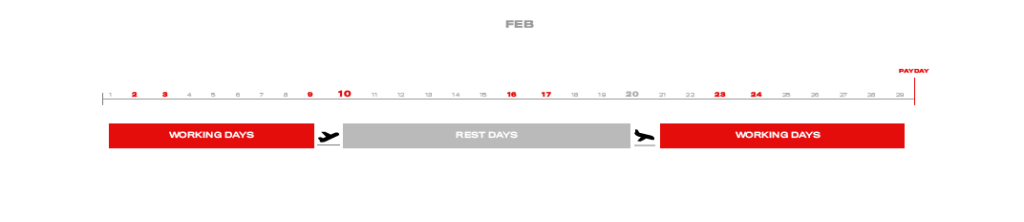
Scheduling the rest and recovery period is also subject to ensuring minimum residual capacity in the office. These periods are to be schedule and approved with minimum 30 days in advance using the planner.anneberg.net platform.
Conclusion
It is of vital importance that you understand and verify the data provided in the payslips (Lohn- und Gehaltsausdruck). For further explanations regarding the payslips you can refer to the article: German payslip explained. If there are any uncertainties regarding your payslip, feel free to open a ticket on support.anneberg.net.
until June 2019
For example, the salary received on the 28 of March 2019 is comprised of the following:
- base salary calculated between 1 and 31 March 2019 for the days worked
- daily expense allowance (per diem) accrued for the days worked between 15 February and 15 March 2019
- whatever compensations / adjustments (korrekturauszahlung) has rolled over from previous month. These can be either positive (adding more to the total amount) or negative (reducing the total received amount)
- the bonuses granted / agreed upon

after June 2019
Following a number of discussions with the posted / foreign employees the management of Anneberg Transport decided to reorganise the salary / wage payment procedures to ensure a better transparency and accountability regarding this important topic. As a result starting with the month of June 2019 the calculation method for the wage will align the base salary with the payment of daily expense allowance (per diem). As a result, the salary received by an employee on the bank account on the 30 august 2019 will be comprised of:
- base salary calculated between 15 July and 15 August 2019 for the days worked
- daily expense allowance (per diem) accrued for the days worked between 15 February and 15 March 2019
- whatever compensations / adjustments (korrekturauszahlung) will rolled over from the previous month. These can be either positive (adding more to the total amount) or negative (reducing the total received amount)
- the bonuses granted / agreed upon
